

Traveling with an emotional support animal (ESA) can be life-changing. This is especially true for people who need their pet to help with anxiety, depression, or other mental health issues.
However, taking your ESA on a flight isn’t as simple as showing up at the airport with your pet. You need a valid ESA travel letter. This letter is important for showing you can travel with your emotional support animal.
Unfortunately, many people are confused about what makes an ESA letter legitimate or where to get one. This guide from Wellness Wag will explain what you need to know about getting a real ESA travel letter. It will also cover airline rules and your legal rights when flying with your ESA.
What is an ESA Travel Letter?
An ESA travel letter is an official document. A licensed mental health professional (LMHP) writes and signs it. This letter confirms your need for an emotional support animal. It verifies that your animal provides therapeutic benefits that help you manage symptoms of a mental or emotional disability.
Key Components of a Valid ESA Letter
To be considered legitimate, your ESA letter must include specific details:
- The professional’s name, license number, and state of practice
- The date of issuance and expiration (usually valid for one year)
- A statement that confirms you have a mental or emotional health condition listed in the DSM-5.
- Confirmation that your ESA provides emotional or psychological support that alleviates symptoms
- The professional’s signature and contact information
Without these elements, airlines or housing authorities may reject your emotional support animal documentation.
Difference Between ESA Letters and Service Animal Documentation

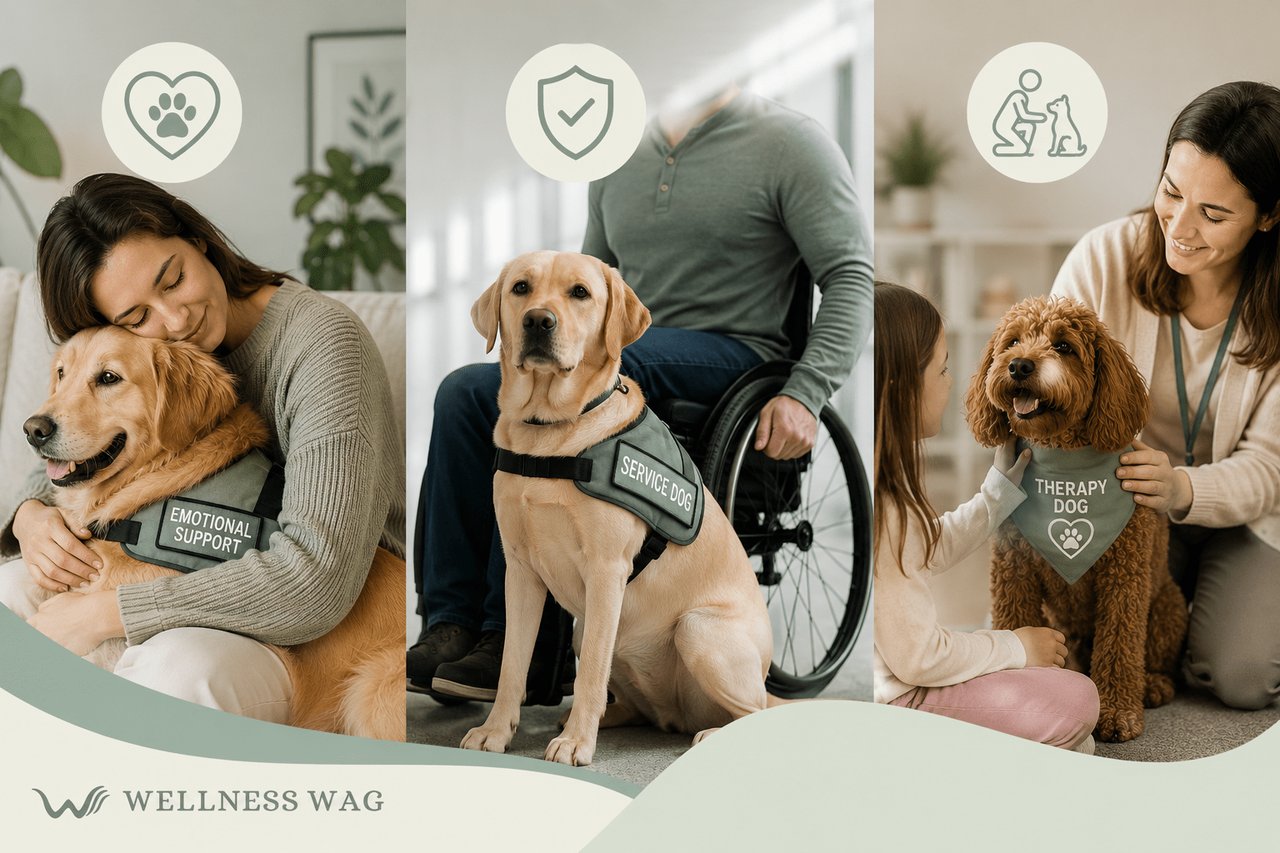
ESA Letters VS Service Animal Documentation
Many people mistakenly believe that ESA and service animals are the same. However, they are not.
Service Animal Documentation
- A service animal is a dog of any breed or size. The program helps a person with a disability.
- The task must directly relate to the person’s disability. For example: retrieving items for someone in a wheelchair, alerting to a seizure, reminding someone to take medication.
- The ADA states that comfort, companionship, or emotional support alone do not qualify as tasks for service animals.
- Public places and businesses open to the public allow service animals. This is true even if there is a “no pets” policy. However, valid reasons can exclude them. For example, if the dog is not housebroken, is out of control, or if its presence would change the nature of the service.
- If the business is not sure if a dog is a service animal, staff can ask two questions. The first question is: Is the dog a service animal needed because of a disability?
- What work or task has the trainer taught the dog to perform?
- They may not ask for proof of certification. They may not ask the dog to show the task. They also may not ask about the person’s disability.
Emotional Support Animal Documentation
- An ESA is an animal that helps people with mental health issues. This can include pets like cats, dogs, rabbits, birds, and even hedgehogs. These animals provide emotional support, comfort, and companionship.
- The key difference: ESAs are not trained to perform a specific task for the disability. Their value lies in their presence, which helps alleviate symptoms of a mental or emotional health condition.
- To have an ESA legally, a person usually needs a letter from a licensed mental health professional. This letter, often called a “prescription,” indicates that the person’s disability requires the ESA.
- People recognize ESAs primarily in housing contexts (via the Fair Housing Act) rather than universally in all public spaces. For example, colleges must allow an ESA in housing if proper documentation is provided.
| Feature | ESA Letter | Service Animal Documentation |
|---|---|---|
| Purpose | To confirm mental/emotional disability and need for emotional support | To show the dog is trained to perform specific disability-related tasks |
| Issued By | Licensed mental health professional | Trainer, organization, or self-training proof (if applicable) |
| Legally Required? | Yes — for housing and some travel | No — under ADA, not required for public access |
| Applies To | Emotional Support Animals (any domesticated pet) | Service Dogs (and in rare cases, miniature horses) |
| Legal Rights | Housing rights under FHA | Public access, housing, and travel rights under ADA & ACAA |
| Training Requirement | None | Must be task-trained to assist with a disability |
| Valid Duration | Typically 1 year | Ongoing, as long as the animal remains trained and under control |
The Americans with Disabilities Act (ADA) protects service animals. An emotional support animal (ESA) is protected by certain laws. These include the Fair Housing Act (FHA) and the Air Carrier Access Act (ACAA).
Following is the table that shows the difference between the ESA Letter and Service Animal Documentation.
Definition and Legal Status
“A legitimate ESA letter serves as formal proof that you qualify for housing protections under relevant laws. It links your mental or emotional health condition with the accommodation of an emotional support animal.”
How to Obtain a Legitimate ESA Travel Letter

Legitimate ESA Travel Letter
Getting a real ESA letter requires following a few simple but essential steps. With the help of Wellness Wag, the process becomes secure, professional, and convenient.
Qualified Healthcare Providers for Legitimate ESA Letter
Only licensed professionals can issue a valid ESA travel letter. These may include:
- Licensed psychologists
- Licensed clinical social workers (LCSWs)
- Psychiatrists
- Licensed professional counselors (LPCs)
- General physicians with mental health training
Before giving the letter, the professional must check your mental health. They will decide if an ESA can help with your symptoms.
The Evaluation Process for Legitimate ESA Letter

At Wellness Wag, the evaluation process is simple and entirely online:
- Fill out a confidential questionnaire about your mental and emotional health.
- Get connected to a licensed provider in your state for review.
- If approved, you’ll receive a legitimate ESA travel letter signed by your provider.
The entire process can often be completed in as little as 24 hours. Online evaluations are convenient. They help people with anxiety or limited mobility get the help they need more easily.
Red Flags of Fake ESA Letters
Unfortunately, the internet is full of scams promising “instant ESA letters” with no evaluation. These fake ESA letters can lead to serious issues, such as being denied boarding or fined by the airline.
Watch out for these warning signs:
- No licensed professional information on the letter
- Instant approval without evaluation
- Lifetime validity (real ESA letters usually expire after 12 months)
- No contact information for the provider
Choosing a reputable service like Wellness Wag ensures your ESA travel letter meets all legal and ethical requirements.
Airline Policies and ESA Letter Requirements
Flying with an emotional support animal used to be easier, but airline regulations have changed significantly in recent years. Understanding airline ESA requirements is crucial before you book your flight.
Current Airline Regulations
In 2021, the U.S. Department of Transportation (DOT) changed the Air Carrier Access Act (ACAA). Now, airlines can treat ESAs as pets instead of service animals. This means that not all airlines are required to accept emotional support animals in the cabin.
Some airlines may still allow ESAs under specific conditions, while others require passengers to register them as regular pets. Always review your airline’s emotional support animal travel policy before your flight.
Airline ESA Requirements for the Submission Process
If your airline accepts ESAs, you will typically need to provide your ESA letter and complete additional forms before your flight. Common requirements include:
- Submitting the ESA travel letter at least 48 hours before departure
- Providing proof of your animal’s vaccinations and health status
- Ensuring your animal can fit safely under the seat or in your lap
- Signing a behavior attestation confirming your ESA is well-behaved in public
Each airline has its own policies, so always check their official website or contact customer support for guidance.
Advance Notice Requirements
Most airlines require advance notice when flying with an ESA. Failing to submit documentation on time could result in denial of boarding. It’s best to start the documentation process well before your travel date to avoid last-minute stress.
For the latest and official travel requirements, refer to the Department of Transportation guidelines.
Legal Rights and Limitations

While ESA travel letters provide valuable rights, it’s important to understand the current laws and their limitations.
Air Carrier Access Act Updates
Previously, the Air Carrier Access Act (ACAA) required airlines to accommodate emotional support animals. However, recent updates have shifted this policy. Airlines now only legally accept service animals.
Having a real ESA letter shows your true need. This is especially helpful when asking for travel or housing accommodations.
You can read the Air Carrier Access Act for full details on your rights.
State-Specific Regulations
Some states have their own laws protecting ESA owners. For example, some housing laws still require landlords to accept tenants with emotional support animals. This is true if they have a valid ESA letter. However, travel laws vary by state and airline, so always check both local and airline-specific rules before traveling.
Common Legal Misconceptions
Here are a few common misunderstandings about ESA letters:
- My ESA can fly for free anywhere. Not always. Some airlines now treat ESAs as pets.
- I can get an ESA letter without an evaluation. False — it must come from a licensed provider.
- An ESA letter lasts forever. Incorrect — it must be renewed annually.
By staying informed and prepared, you can protect your rights and avoid unnecessary travel complications.
Conclusion
A valid ESA travel letter is essential for anyone planning to travel with an emotional support animal. It proves your need for emotional assistance and ensures that your travel experience is as smooth as possible.
It’s important to know that not all ESA letters are real. Only licensed mental health professionals can give them. These letters must follow certain legal and documentation rules.
With Wellness Wag, the process of getting a legitimate ESA letter is simple, secure, and completely online. A professional will guide you through an evaluation and provide you with certified documentation that meets all ESA letter requirements.
If you are planning to travel with an emotional support animal, it’s important to have an ESA letter. Make sure to get this letter from a reliable source. This will help you feel more at ease during your trip. This will help make your journey stress-free.
Ready to travel confidently with your emotional support animal? Start your evaluation today with Wellness Wag and get your ESA travel letter from a licensed professional.






 Ask ChatGPT
 Ask Claude
 Ask Perplexity