

Introduction: Your ESA is Still Protected—Here’s Proof
Your landlord said no to your emotional support animal. That message hit like a punch, especially if you’ve been reading headlines about HUD’s May 2026 policy change. But here’s what the news didn’t tell you: your ESA letter is still valid, and your landlord’s denial may violate federal law.
On May 22, 2026, the U.S. Department of Housing and Urban Development (HUD) withdrew its 2013 and 2020 guidance that treated ESAs as assistance animals. That withdrawal created confusion; landlords started denying requests they would have approved a year ago. But the HUD memo changed how HUD enforces complaints. It did not repeal the Fair Housing Act, which is the federal law that actually protects you.
This guide walks you through exactly what to do if your landlord denies your ESA, step by step. You have legal remedies, and you don’t need to move out or panic.
Understanding Why Your Landlord Said No (and Why They May Be Wrong)
Before we get to solutions, let’s talk about why this is happening.
In May 2026, HUD adopted a new “trained task” standard for complaints it pursues directly. Instead of treating untrained ESAs as automatic reasonable accommodations, HUD now requires animals to be individually trained to perform a specific, disability-related task, similar to how the ADA defines service dogs.
What many landlords misread: they thought this meant ESA denials are now legal. They’re not.
The 2026 HUD ESA Memo: What Changed vs. What Didn’t
| WHAT CHANGED | WHAT DIDN’T CHANGE |
|---|---|
| HUD’s Old Guidance is Gone — HUD permanently cancelled its 2013 and 2020 ESA guidance that told landlords to treat ESAs as assistance animals | The Fair Housing Act Itself — The federal law (42 U.S.C. § 3604) that makes disability discrimination in housing illegal has not been repealed, amended, or struck down |
| A New “Trained Task” Standard — For complaints HUD pursues, it now looks for animals individually trained to do a specific, disability-related task, closer to the service-dog rule | Your Right to Take Legal Action — You can still sue a landlord in federal or state court within two years of the violation (42 U.S.C. § 3613). No agency needs to be involved |
| HUD Stepped Back From Enforcement — Staff were told to stop chasing complaints about untrained ESAs, and open cases are under review | Every State and Local Law — HUD’s memo does not override state or local fair housing laws, Section 504, or the ADA. Many states protect ESA owners beyond the federal minimum |
| The Presumption Flipped — Before, an untrained ESA was presumed a reasonable accommodation. For HUD’s own enforcement, that presumption no longer applies | Approvals You Already Have — If your landlord already approved your ESA, that accommodation stands. Nothing in the memo allows a landlord to revoke an existing reasonable accommodation |
The 5-Step Action Plan: What to Do When Your Landlord Says No
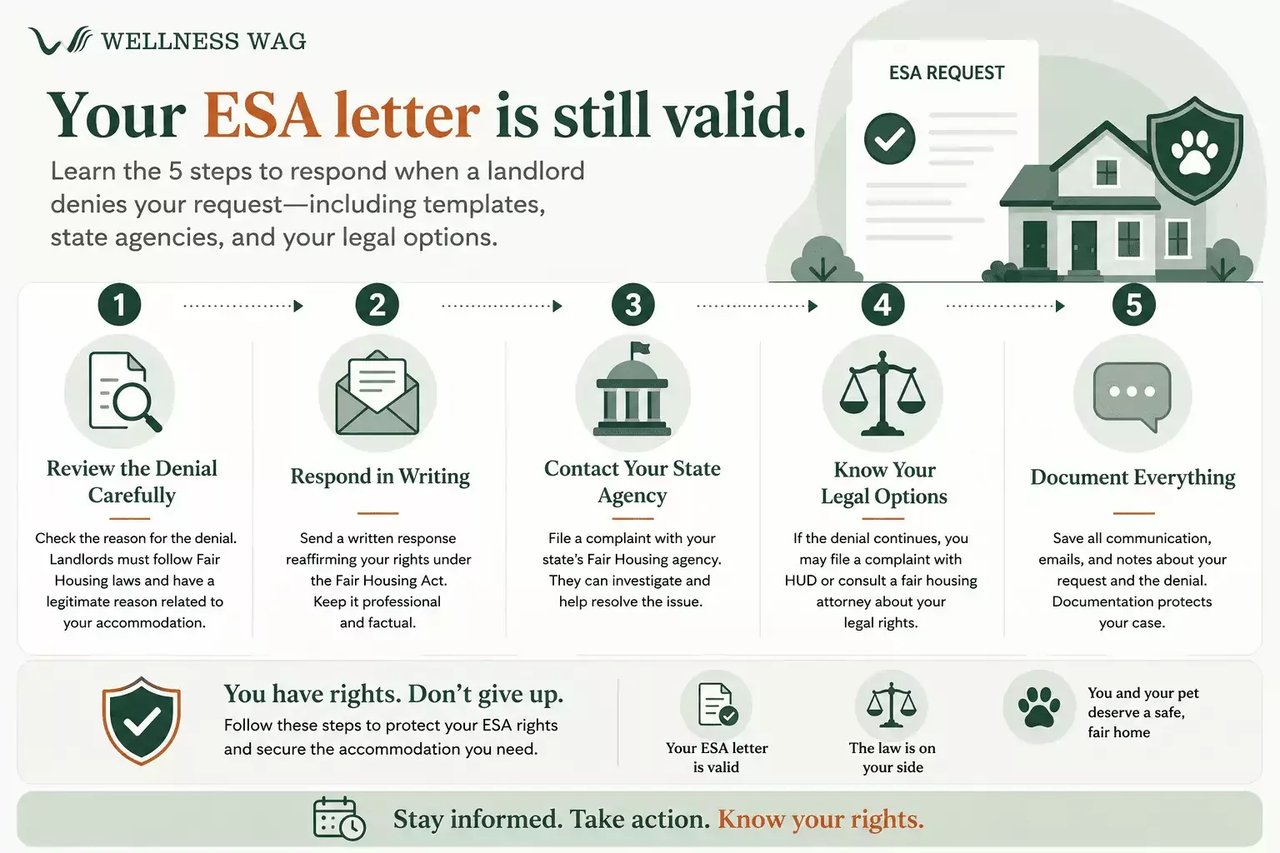
If your landlord has denied your ESA request, follow these steps in order. Each one strengthens your position.
Step 1: Don’t Panic—And Don’t Move Out
A denial is not the final word. You have time and legal options. Moving out, even under pressure, can weaken your case and may be unnecessary.
Your landlord’s denial may be:
- Premature — They didn’t adequately review your documentation
- Based on misunderstanding — They confused the HUD policy change with a law change
- Pretextual — The real reason is disability discrimination (which is illegal)
Stay calm, stay put, and move to Step 2.
Step 2: Re-Request in Writing with Your Current ESA Letter Attached
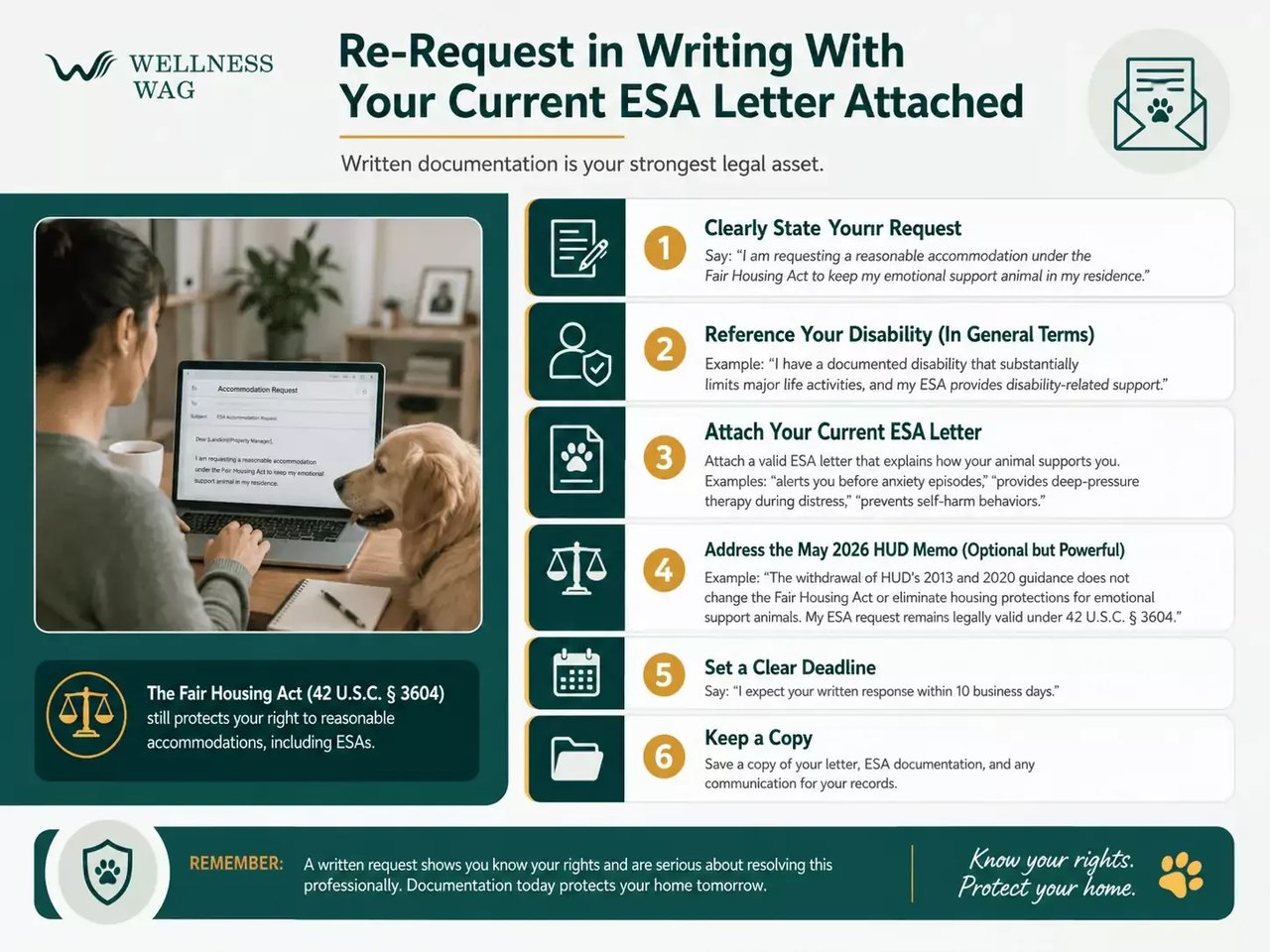
This is the most important step. Written documentation is your strongest legal asset.
Send a formal letter (email is acceptable, but certified mail is stronger) that:
- Clearly states your accommodation request — “I am requesting a reasonable accommodation under the Fair Housing Act to keep my emotional support animal in my residence.”
- References your disability (in general terms) — “I have a documented disability that substantially limits major life activities, and my ESA provides disability-related support.”
- Attaches your current ESA letter — Ideally one that describes specific ways your animal supports your condition (e.g., “alerts you before anxiety episodes,” “provides deep-pressure therapy during distress,” “prevents self-harm behaviors”).
- Addresses the May 2026 HUD memo head-on (optional but powerful) — “The withdrawal of HUD’s 2013 and 2020 guidance does not change the Fair Housing Act or eliminate housing protections for emotional support animals. My ESA request remains legally valid under 42 U.S.C. § 3604.”
- Sets a clear deadline — “I expect your written response within 10 business days.”
- Keeps a copy — Save everything.
Why this works: Landlords often cave once they realize you know the law. If they don’t, you now have written evidence they were warned and proceeded anyway, that’s gold in court.
Free ESA Re-Request Template
You can copy and customize this template:
- [DATE]
- [LANDLORD/PROPERTY MANAGEMENT NAME]
[Address]
Re: Reasonable Accommodation Request for Emotional Support Animal Dear [Landlord/Manager],
I am writing to formally request a reasonable accommodation under the Fair Housing Act (42 U.S.C. § 3604) to keep my emotional support animal in my residence at [property address].
I have a documented disability, and my ESA provides disability-related support that is necessary for me to enjoy the full use and enjoyment of my home. My ESA letter from [licensed mental health provider name] is attached and confirms this relationship.
I understand that HUD withdrew certain guidance in May 2026. However, this administrative change does not alter my legal rights under the Fair Housing Act, which remains in full effect. Reasonable accommodation requests backed by valid documentation from licensed mental health professionals continue to be legally required.
I request your written approval of this accommodation within 10 business days of this letter. If you have questions or need additional information, please get in touch with me at [phone/email].
Thank you for your prompt attention to this matter.
Sincerely,
[Your Name]
[Date]
- Attachment: [Current ESA Letter from Licensed Provider]
- Send this to: Your landlord or property manager, certified mail (receipt of delivery is proof they got it), email with read receipt, or both.
Step 3: File a Complaint with Your State or Local Fair Housing Agency
If your landlord ignores Step 2 or denies you again, file a formal complaint. This is independent of HUD; your state or local agency enforces fair housing law on its own.
You have one year from the date of the violation to file under most state laws, or up to two years under the federal Fair Housing Act.
Where to file:
- California: California Civil Rights Department (CRD)
- New York: NY Division of Human Rights (state) or NYC Commission on Human Rights (city)
- Washington: Washington State Human Rights Commission
- Florida: Florida Commission on Human Relations
- Texas: Texas Workforce Commission, Civil Rights Division
- Arizona: Arizona Attorney General, Civil Rights Division
Unsure? Check the Fair Housing Act enforcement agency for your state or contact your state attorney general.
What the complaint triggers: A formal investigation. The agency will contact your landlord, ask for their reasoning, and assess whether the denial violated fair housing law. Many cases settle at this stage; landlords realize fighting is costly, and they’re likely to lose.
Step 4: Ask About Section 504
If your building receives any federal funding, HUD-backed mortgages, Section 8 vouchers, community development grants, etc., Section 504 of the Rehabilitation Act (29 U.S.C. § 794) applies independently of the Fair Housing Act.
Section 504 has its own enforcement pathway and may provide additional protections.
How to check: Ask your landlord directly: “Does this building receive federal funding?” If yes, mention in your written request that Section 504 applies, which may strengthen your position.
Step 5: Get Backup and Know You Can Sue
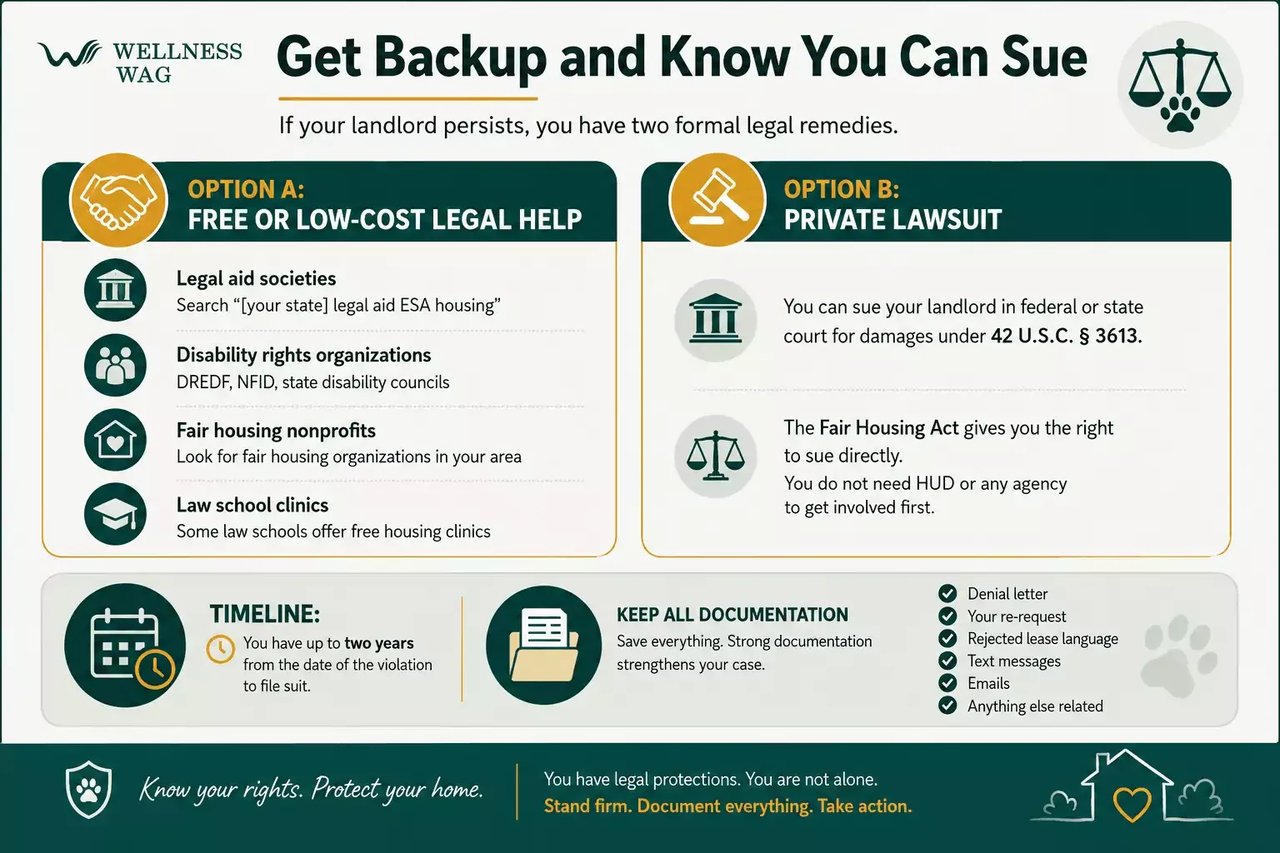
If your landlord persists, you have two formal legal remedies:
Option A: Free or Low-Cost Legal Help
- Legal aid societies (search “[your state] legal aid ESA housing”)
- Disability rights organizations (DREDF, NFID, state disability councils)
- Fair housing nonprofits in your area
- Some law schools offer free housing clinics
Option B: Private Lawsuit You can sue your landlord in federal or state court for damages under 42 U.S.C. § 3613. The Fair Housing Act gives you the right to sue directly; you do not need HUD or any agency to get involved first.
- Timeline: You have up to two years from the date of the violation to file suit. Keep all documentation (denial letter, your re-request, rejected lease language, text messages, emails—everything).
- What courts award: Actual damages (economic losses: deposits forfeited, moving costs, etc.), punitive damages for willful violations, and attorney fees. Courts have awarded ESA owners thousands of dollars for illegal denials.
What You Need to Know About Recent Court Rulings (and What They Don’t Say)
You may have heard about Henderson v. Five Properties (E.D. La. 2025), a Louisiana court case sometimes cited to argue ESA denials are now legal.
- What Henderson actually said: A judge in one Louisiana federal court ruled that a landlord was not necessarily bound by HUD’s old guidance on untrained ESAs. The case involved a pet fee, not a housing denial. Importantly, Henderson followed the 2024 Supreme Court decision in Loper Bright Enterprises v. Raimondo, which reduced judicial deference to agency guidance generally.
- What Henderson did NOT say: That ESA letters are now invalid, or that landlords can deny them without review.
- Why it doesn’t help your landlord: Henderson is persuasive in some circuits but binding nowhere nationwide. Courts in California, New York, Washington, and other states continue siding with tenants who have valid ESA documentation. Many judges view Henderson as a narrow opinion about one landlord’s defenses, not a green light for blanket denials. Bottom line: A narrow Louisiana ruling does not overturn the Fair Housing Act or give landlords a free pass.
State-by-State Protections: Your State May Offer More Than Federal Law
The Fair Housing Act is the floor, not the ceiling. Many states have passed their own laws that protect ESA owners beyond what federal law requires. Knowing this strengthens your negotiating position.
California: The Gold Standard
California’s FEHA + AB 468 require ESA letters from licensed mental health professionals and set clear documentation standards. Landlords cannot demand excessive proof or dispute valid letters. The California Civil Rights Department (CRD) actively pursues ESA housing cases. Mention AB 468 in your re-request letter. If denied, file with CRD (888) 568-9197—they move quickly.
New York: The Tenant’s Champion
New York City’s Human Rights Law requires landlords to engage in “cooperative dialogue” with tenants requesting ESAs, they cannot auto-deny. The NYC Commission on Human Rights treats these violations seriously. New York also limits how much documentation landlords can demand beyond a licensed provider’s letter. Reference the “cooperative dialogue” requirement in your letter. If ignored, that’s itself illegal in NYC.
Washington: No Exemptions
Washington’s Law Against Discrimination (WLAD) covers ESAs with no small-landlord exemptions—meaning even a single-unit landlord must comply. This is rare; most states allow exemptions for small buildings. The Washington State Human Rights Commission enforces it. Use this in your letter if your landlord claims exemption: “RCW 49.60.222 has no small-landlord exemptions for disability accommodations.”
Florida: Statutory Roadmap
Florida has a dedicated ESA statute (§ 760.27) that spells out exactly what landlords must do: review documentation, cannot charge pet fees, cannot refuse based on breed or size. The fact that the state legislature created this specific law gives it extra legal weight. Quote § 760.27 in your re-request letter. The Florida Commission on Human Relations enforces it. This shows Florida has already addressed ESA denials.
Texas: Dual Enforcement Path
Texas’s Fair Housing Act (Prop. Code Ch. 301) mirrors federal protections but has its own independent state agency: Texas Workforce Commission (TWC). This is valuable because you can file complaints with both HUD and TWC—one might move faster than the other. File with both agencies if denied. Having two agencies investigating strengthens your case.
Arizona: Attorney General Takes Action
Arizona’s Fair Housing Act mirrors federal requirements, but the Arizona Attorney General’s office actively pursues ESA cases (recovered $2M+ in 2025 alone). This track record deters landlord denials—they know the AG will come after them. File complaints with Arizona’s AG office if denied. The AG’s enforcement record gives your case real teeth.
Your State Not Listed?
The Fair Housing Act (42 U.S.C. § 3604) still applies everywhere, and nearly every state has its own fair housing agency. Search “[Your State] fair housing agency” or contact your state attorney general. Many states have specific ESA statutes they don’t advertise, ask.
In your re-request letter, always cite:
- Federal Fair Housing Act § 3604
- Your state’s specific law (if it exists)
- Your state agency’s name (shows you know who enforces it)
This combination tells your landlord: “I know the law and who enforces it.”
If you’re in any of these states, mention your state law in your re-request letter. It shows you know the landscape.







 Ask ChatGPT
 Ask Claude
 Ask Perplexity