

Your Rights When a Landlord Denied Your ESA Letter
If your landlord refused your ESA letter, you still have options. Under the Fair Housing Act (FHA), most landlords in the United States must make reasonable changes for people who need emotional support animals. A denial does not mean the process is over. It means you should take the correct steps to protect your rights.
The Fair Housing Act is a federal law that protects people with disabilities from housing discrimination. For ESA owners, this means landlords usually must allow emotional support animals, even in places with a no-pets rule. They also cannot charge pet fees or extra rent for an ESA. In most cases, they also cannot deny your ESA because of its breed or size. Under federal law, an ESA is not treated like a normal pet. It is considered an assistance animal, which gives it stronger legal protection.
The U.S. Department of Housing and Urban Development (HUD) enforces this law through its Office of Fair Housing and Equal Opportunity (FHEO). HUD says that landlords cannot refuse reasonable requests that help a person with a disability fully enjoy their home. If a landlord refuses without a valid legal reason, you have the right to take action.
This guide explains each step, including why an ESA letter may be denied and how to file an official HUD complaint.
Why ESA Letter Rejected by the Landlord?
Not every ESA denial breaks the Fair Housing Act. Sometimes, a landlord may have a legal reason to deny the request. But many denials are not allowed by law. Knowing the difference can help you understand your rights.
Legal Reasons a Landlord Can Deny Your ESA
- A landlord can deny an ESA if the animal is a real danger to other people. This must be based on the animal’s actual behavior. A landlord cannot deny an ESA just because of its breed, size, or type.
- A landlord can deny an ESA if the animal has a history of causing major property damage. The landlord must have proof of the damage. They cannot deny the request based only on fear or guesses.
- In rare cases, a landlord may deny the request if it causes a major financial or management problem. This usually applies only to very small housing providers.
Illegal Reasons Landlords Often Give for ESA Denial
Many landlords deny ESA requests for reasons that are not allowed under federal law. Some common examples include:
- The building has a no-pets rule. A no-pets policy does not cancel your rights under the Fair Housing Act.
- The ESA is a restricted breed or weighs too much. Breed and weight limits usually do not apply to assistance animals.
- The landlord’s insurance does not cover the animal. Insurance rules do not remove your legal rights as a tenant.
- The ESA letter came from an online service. What matters is whether a licensed professional completed a real evaluation, not whether it was done online.
- The landlord says they do not accept ESAs. This is not a valid legal reason to deny your request.
If your landlord denied your ESA for any of these reasons, you may have a strong case for filing a formal complaint.
Housing Types That Are Exempt
There are a few situations where the Fair Housing Act may not apply. According to HUD and federal law, this can include small owner-occupied buildings with four or fewer units. It can also include single-family homes rented by a private owner without using a real estate agent.
What to Do When a Landlord Denies Your ESA Letter
Step 1: Get the Denial in Writing
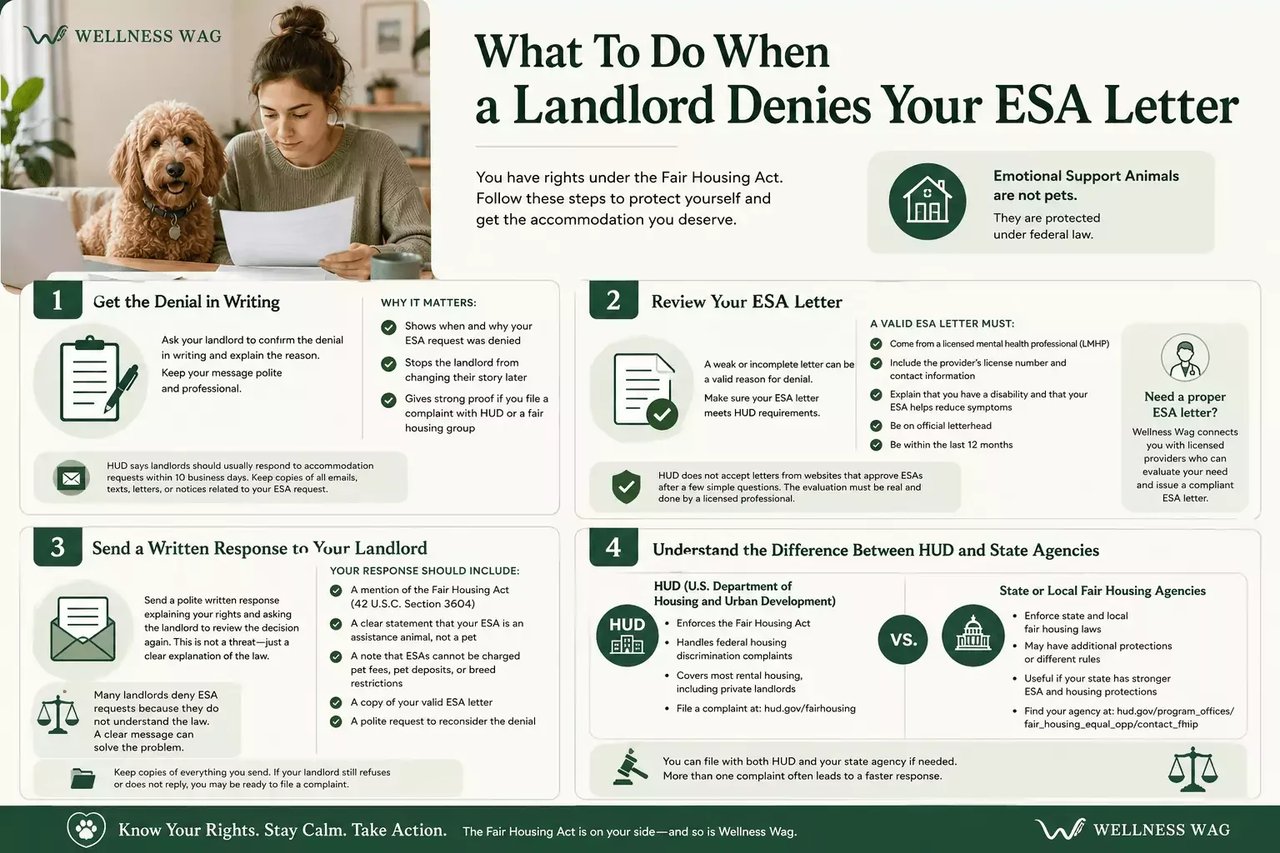
Before doing anything else, ask your landlord to give the denial in writing. If they only told you verbally, send a short email asking them to confirm their decision and explain the reason. Keep your message polite and professional.
A written denial is important for several reasons:
- It shows when and why your ESA request was denied.
- It stops the landlord from changing their story later.
- It gives strong proof if you file a complaint with HUD or a fair housing group.
If your landlord does not reply, that can also be a problem. HUD says landlords should usually respond to accommodation requests within 10 business days. If they delay too long without a reason, HUD may treat it like a denial.
Keep copies of every email, text message, letter, or notice related to your ESA request. Save them in one folder, either on paper or on your computer. You may need these records later.
Step 2: Review Your ESA Letter
Before filing a complaint, carefully review your ESA letter. A weak or incomplete letter can be a valid reason for denial. Fixing any problems first can make your case stronger.
Under HUD rules, a valid ESA letter must meet these requirements:
- It must come from a licensed mental health professional (LMHP), such as a therapist, psychologist, psychiatrist, or clinical social worker.
- The professional must be licensed in your state and must either treat you or complete a real evaluation of your condition.
- The letter must explain that you have a disability and that your ESA helps reduce symptoms of that disability.
- It must be written on official letterhead and include the provider’s license number and contact information.
- The letter must still be valid. Most ESA letters expire after one year.
HUD says that letters from websites that give approvals after only a few simple questions are usually not enough. The evaluation must be real and done by a licensed professional.
If your ESA letter does not meet these rules, update it before filing a complaint. A strong and legal ESA letter can help remove one of the main reasons a landlord may use to deny your request.
If you need to get a proper ESA letter from a licensed provider, Wellness Wag connects you with qualified mental health professionals who can evaluate your need and issue a compliant ESA letter.
Step 3: Send a Written Response to Your Landlord
After you have proof of the denial and a valid ESA letter, send a written response to your landlord. This is not a threat or demand letter. It is a polite message that explains your legal rights and asks the landlord to review the decision again.
Your written response should include:
- A mention of the Fair Housing Act (42 U.S.C. Section 3604) and your right to a reasonable accommodation.
- A clear statement that your ESA is an assistance animal under federal law, not a pet.
- A note that ESAs cannot be charged pet fees, pet deposits, or breed restrictions under the Fair Housing Act.
- A copy of your valid ESA letter attached to the message.
- A polite request asking the landlord to reconsider the denial.
Many landlords deny ESA requests because they do not fully understand the law. A clear message that explains your rights can solve many problems before they become more serious.
Keep copies of everything you send. If the landlord still refuses your request or does not reply within a reasonable time, you may be ready to file an official complaint.
Step 4: Understand the Difference Between HUD and State Agencies
You have two main ways to file a formal complaint. You can file through the federal HUD complaint process or through a state fair housing agency. In many cases, HUD works together with state and local housing agencies through the Fair Housing Assistance Program (FHAP).
Learning about both options can help you choose the best way to handle your case.
| Feature | HUD (Federal) | State Fair Housing Agency |
|---|---|---|
| Who administers it | U.S. Dept. of Housing and Urban Development | State or local civil rights office |
| Cost to file | Free | Free in most states |
| Time limit to file | 1 year from date of violation | Varies by state (often shorter) |
| Investigation timeline | Approximately 100 days | Varies by agency |
| Outcome options | Injunctive relief, damages, civil penalties | Varies; some states offer stronger remedies |
| How to file | Online at hud.gov, by phone, mail, or in person | Through your state’s civil rights or housing office |
| Can you file both? | Yes, but HUD may defer to state agency if they have a certified partnership | Yes, in some cases |
| Retaliation protection | Yes, under the Fair Housing Act | Yes, under most state laws |
How to File a HUD Complaint ESA
Filing a complaint with HUD is free and does not require a lawyer. Here is exactly how to do it.
- Gather Your Documents First
Before you start the complaint form, collect all important papers. This will make the process easier.
You will need:
- Your valid ESA letter from a licensed mental health professional
- Proof that you asked for an ESA (email, letter, or written message)
- Your landlord’s written denial, or proof that they did not respond
- Any other messages or communication with your landlord about the ESA
- Your landlord’s full name, business name (if they have one), and the property address
- Complete the HUD Form 903
Go to HUD’s official housing discrimination complaint form. You can also file your complaint online, call 1-800-669-9777, or mail a printed form to your local FHEO office. The form will ask you for:
- Your name and contact details
- The name and address of the landlord or company you are reporting
- The address of the property involved
- A simple explanation of what happened
- The dates when it happened
- Write a Clear Description
In the description box, write only clear facts. Do not use emotional words. Just explain what happened.
- A good complaint should include:
- The date you sent your ESA letter and request
- What your landlord said or did after that
- Any follow-up messages you sent
- Why you think the denial goes against the Fair Housing Act
Keep your explanation simple, clear, and based only on facts and dates.
- Submit and Keep Your Confirmation
After you send your complaint online, you will get a confirmation number. Save this number. HUD will review your complaint to see if it follows the rules. If needed, they may contact you and ask for more information before they officially open the case and inform your landlord.
- What Happens After You File
Once HUD officially opens your case, the investigation starts.
- HUD usually investigates the complaint within about 100 days.
- They collect evidence, talk to both sides, and check all documents.
- HUD may also offer mediation, which is a way to solve the problem without a full investigation.
- If mediation does not work and discrimination is found, HUD can take legal action.
If HUD believes discrimination likely happened, they issue a “Charge of Discrimination.” After this, both sides have 20 days to choose whether the case goes to an administrative law judge or to federal court.
Possible results may include changes to the landlord’s policies, payment of legal costs, or other legal penalties.
What to Do If Your Landlord Denied an ESA Letter and Then Retaliates
- Filing a complaint can feel scary. Some tenants worry their landlord might punish them for speaking up. But federal law makes this illegal.
- The Fair Housing Act says a landlord cannot punish you for asking for an ESA or for filing a HUD complaint. This is called retaliation. Retaliation means any negative action taken because you used your legal rights. This can include raising rent suddenly, threatening eviction, harassment, or cutting off services in the building.
- If anything like this happens after you file, write it down right away. Include the date, what happened, and how it was done. Save all texts, emails, and letters.
- Then report it to HUD as a separate complaint. You do not have to wait for your first case to finish. File it quickly, because retaliation is taken very seriously under the law.
Do You Need a Lawyer After Your Landlord Denies Your ESA Letter?
You do not always need a lawyer. Many people fix ESA problems by filing a complaint with HUD without legal help. But in some cases, a lawyer can be very helpful.
You may want to talk to a lawyer if:
- Your landlord ignores your ESA request and your written reply
- Your landlord starts punishing you, like threatening eviction or harassing you
- You lose money because of the denial, such as paying extra fees or needing to move
- HUD closes your case, but you believe the decision was wrong
A fair housing lawyer can send a strong legal letter to your landlord for you. This often solves the problem quickly. They can also help you if the case goes to court.
Under the Fair Housing Act, you can also file a private lawsuit within two years of the discrimination. You can do this even if you already filed a HUD complaint.
You can find a lawyer through local legal aid offices or your state bar association referral service.
Free Resources to Help When Your Landlord Denied Your ESA Letter
- You do not have to handle this alone. There are free groups that help people with ESA problems.
- Local fair housing groups are non-profit organizations. They help people who face housing discrimination at no cost. They can check your ESA letter, help you reply to your landlord, and guide you step by step through the HUD complaint process.
- They can also tell you if your landlord must follow the Fair Housing Act. This is important because some small buildings are not covered by the law.
- To find a HUD-approved fair housing group near you or call 1-800-669-9777. You can also contact the National Fair Housing Alliance at FAHO to find help in your area.
Conclusion
If your landlord denies your ESA letter, it may feel unfair. But the law is not against you. The Fair Housing Act is made to protect people in situations like this. You have rights, and there is a clear process to help you use them. Free government help is also available.
Start by asking for the denial in writing. Check your ESA letter to make sure it is correct. Then send a polite written reply to your landlord. If they still refuse, you can file a free complaint with HUD at hud.gov. This is your legal right. It is also illegal for your landlord to punish you for doing this. You usually have one year from the denial date to file, so it is important to act on time.
You do not have to choose between your mental health and your home. Federal law protects both.
If you need a properly prepared ESA letter before moving forward, Wellness Wag can connect you with a licensed mental health professional who can review your situation and provide a valid ESA letter if you qualify.







 Ask ChatGPT
 Ask Claude
 Ask Perplexity